
Best Financial Data APIs for Qoder适合 Qoder 的最佳金融数据 API
Compare financial data APIs for Qoder across market data, filings, macro coverage, freshness, licensing, and agent readiness.
从行情、监管文件、宏观覆盖、时效、许可和智能体适配度,对比适合 Qoder 的金融数据 API。
The short answer
Twelve Data is the most flexible starting point for cross-asset prototypes; Massive is compelling for serious U.S. market-data applications; Financial Modeling Prep is useful when company fundamentals drive the task; and official FRED and SEC EDGAR APIs are the right primary sources for macro series and filings. Alpha Vantage, Finnhub, and Alpaca remain strong when their narrower strengths match the workload.
The best API for Qoder is not simply the one with the most endpoints. It is the one you can expose as a small, typed, read-only tool with timestamps, provenance, stable errors, test fixtures, and licensing that permits your intended use.
How we evaluated financial APIs for Qoder
Qoder can write adapters, validate schemas, build dashboards, and use external systems through Model Context Protocol (MCP). That makes agent usability different from ordinary SDK popularity. A provider is useful only when Qoder can request a bounded operation, understand the response, reproduce it in tests, and tell the user where the data came from.
Right data, not more data
Assets, venues, history, fundamentals, news, filings, and macro series must match the task.
Freshness and provenance
Event time, feed identity, adjustment policy, and delay state should travel with the value.
Small, typed operations
Predictable JSON, narrow endpoints, clear errors, and manageable pagination reduce tool ambiguity.
Docs and testability
Official schemas, examples, sandbox options, and stable identifiers help Qoder generate maintainable code.
Limits and failure modes
Rate limits, reconnect behavior, quotas, and status signals matter more than a perfect demo.
Display and redistribution
An endpoint being technically accessible does not automatically grant product display or redistribution rights.
Quick comparison: best API by Qoder workload
| API | Best for | Primary interface | Main caution |
|---|---|---|---|
| Twelve Data | Cross-asset prototypes | REST, WebSocket | Confirm plan-specific coverage and credits |
| Massive | U.S. market-data apps | REST, WebSocket, flat files | Entitlements vary by market and plan |
| Alpha Vantage | Learning and indicator prototypes | REST | Rate limits shape interactive workflows |
| Finnhub | Quotes plus company/news context | REST, WebSocket | Verify dataset-by-dataset terms |
| Alpaca | Trading-adjacent development | REST, WebSocket | Keep market data separate from execution |
| FMP | Fundamentals and valuation | REST | Normalize point-in-time semantics |
| FRED | Official macroeconomic series | REST | Revisions can change historical values |
| SEC EDGAR | Primary-source U.S. filings | REST/JSON, archives | Respect identity and access guidance |
This is a fit matrix, not a benchmark. Prices, quotas, exchange entitlements, and product names can change; confirm them on each provider's official documentation before implementation.
The 8 best financial data APIs for Qoder
The ordering starts with broadly useful commercial APIs, then moves to specialized and primary-source options. In a production research system, using two or three complementary sources is often more defensible than forcing one vendor to answer every question.
Twelve Data
Best for multi-asset prototypesChoose Twelve Data when Qoder needs one consistent surface for time series across several asset classes and you value quick experimentation.
Its official API documentation covers REST and WebSocket access, making it suitable for both snapshot tools and application-side stream consumers. The consistent time-series shape is helpful when Qoder must generate adapters, chart code, indicators, or test fixtures without learning a different response family for every asset.
Broad experiments, clear time-series requests, stream plus snapshot paths.
Credits, instrument coverage, and freshness depend on the selected plan and market.
Massive
Best Qoder-ready U.S. market dataChoose Massive when the application needs a serious U.S. market-data foundation and Qoder will be building more than a one-off script.
The official documentation presents REST, WebSocket, and bulk-data paths across supported markets. Massive also publishes an official MCP and AI-tools quickstart, including hosted and self-hosted MCP options. That makes it unusually direct for Qoder: use the official MCP path for agent-led discovery and bounded analysis, or let Qoder generate a thin API client while an application-side pipeline handles streams and large historical jobs outside the agent context.
Official MCP support, AI-oriented documentation, multiple delivery modes, and detailed schemas.
Map plan, market, feed, and display rights explicitly; MCP access still follows account entitlements.
Alpha Vantage
Best for learning and indicatorsChoose Alpha Vantage for compact REST experiments, technical-indicator prototypes, and educational projects where request volume is controlled.
Its official API reference groups time series, fundamentals, economic indicators, commodities, currencies, and technical indicators behind function-based requests; Alpha Vantage also provides an official MCP server. Qoder can therefore start through MCP or scaffold a small direct client. In either path, cache stable results and make rate-limit responses a first-class error so a chatty agent does not waste quota.
Official MCP access, simple REST calls, many examples, and useful built-in indicator endpoints.
Low-throughput plans require caching, batching discipline, and deterministic fixtures.
Finnhub
Best for market contextChoose Finnhub when Qoder must combine price observations with company, news, earnings, or alternative-data context.
Finnhub's official API documentation spans market data and company-oriented datasets, with WebSocket support for streaming use cases. This breadth supports research assistants and alert prototypes, but it also increases schema variance. Expose separate tools such as get_quote, get_company_news, and get_earnings_calendar instead of one open-ended proxy.
A useful mix of numerical observations and narrative/company context.
Normalize symbols, timestamps, and error shapes separately for each dataset family.
Alpaca Market Data
Best for trading-adjacent developmentChoose Alpaca when the project sits near brokerage workflows, but keep Qoder's financial-data tools strictly separated from order execution.
Alpaca publishes market-data documentation for historical and real-time access. The shared ecosystem is convenient for portfolio tools, paper-trading applications, and trading-adjacent dashboards. Convenience is not permission: use different credentials, MCP servers, allowlists, and confirmation paths for reads and trades.
Coherent developer ecosystem and realistic paper-development workflows.
Never let a broad tool definition turn a data request into an execution path.
Financial Modeling Prep
Best for fundamentalsChoose Financial Modeling Prep when Qoder is building valuation models, screening companies, or assembling structured company research.
FMP's developer documentation covers statements, ratios, estimates, profiles, and market endpoints. These datasets are useful for code generation because they map naturally to typed domain objects. For defensible analysis, retain filing period, accepted date, currency, reported-versus-derived status, and source URL; a value without its accounting period is easy to misuse.
Structured company data maps well to models, screens, and valuation code.
Point-in-time analysis requires dates, revisions, currencies, and consistent period semantics.
FRED API
Best for macroeconomic dataChoose the Federal Reserve Bank of St. Louis FRED API for official macroeconomic time series and reproducible economic-data workflows.
The official FRED API documentation supports series discovery, observations, releases, categories, and related metadata. It is ideal for Qoder tasks such as building an inflation dashboard, aligning rates with company data, or generating a research notebook. Store series IDs and vintages rather than relying on display names. For historical truth as known on a past date, use the appropriate vintage/revision workflow instead of today's latest revised series.
Stable identifiers, strong metadata, and a clear primary-source role.
Revisions, frequency conversions, units, and release calendars affect interpretation.
SEC EDGAR APIs
Best for primary-source filingsChoose SEC EDGAR when Qoder must inspect U.S. public-company filings, submissions, or XBRL facts from the primary regulator source.
The SEC publishes EDGAR API resources for submissions and XBRL company facts, alongside archives for filing documents. This is not a normalized all-in-one research API; that is precisely why it is valuable for evidence. Make Qoder cite accession number, form type, filing date, period, concept, unit, and source document. Follow the SEC's current access and user-agent guidance.
Primary evidence for filings and structured facts, with durable source identifiers.
Taxonomy changes, units, duplicate facts, amended filings, and access policy require care.
A decision framework that works better than a generic ranking
Name the output
A quote card, valuation model, macro chart, filing citation, and alert service require different evidence. Write the exact fields, symbols, markets, history, update cadence, and final user experience before comparing vendors.
Separate snapshot from stream
Use bounded REST or MCP calls for prompt-time questions. Let an application consumer maintain WebSocket state, then expose a recent snapshot to Qoder. Streaming raw ticks into an agent wastes context and complicates ordering, reconnects, and cancellation.
Test the evidence envelope
Every result should carry provider, dataset/feed, event time, received time, timezone, currency or unit, delay state, and stable identifiers. For fundamentals, add period and filing date; for macro series, add vintage; for news, add publisher and publication time.
Confirm rights before architecture
Internal analysis, customer display, storage, derived analytics, model input, and redistribution can have different terms. Record the approved use alongside the provider configuration; do not leave licensing as a launch-week checklist item.
How to connect a financial API to Qoder
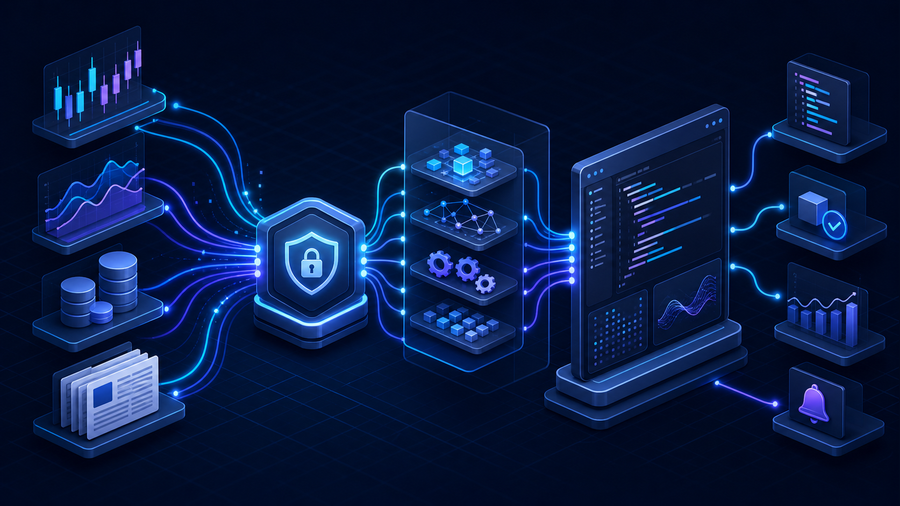
Qoder's official documentation explains that Agent Mode can use external systems through MCP servers, while Qoder CLI supports project-level MCP configuration and permission rules. The safest pattern is provider API → your read-only adapter/MCP server → a few typed tools → Qoder.
Start with one operation such as get_daily_bars or get_company_facts. Keep the provider key on the server, validate inputs, cap date ranges, return provenance, and translate provider errors into a small stable set. Qoder should call a business operation, not construct arbitrary vendor URLs.
{
  "mcpServers": {
    "financial-data": {
      "command": "node",
      "args": ["./tools/financial-data-server.js"],
      "env": { "PROVIDER": "${FINANCIAL_DATA_PROVIDER}" }
    }
  }
}
The configuration is illustrative: keep the secret itself outside committed files. Use QVeris provider discovery to inspect available providers, browse QVeris tools for precise operations, and validate the smallest useful workflow in the QVeris Playground.
Production controls Qoder should help you implement
- Freshness: reject or label observations older than the workload's explicit threshold.
- Provenance: preserve provider, feed, venue, timestamps, units, and transformation steps.
- Schema validation: reject missing fields, non-finite numbers, reversed windows, and unexpected enums.
- Deterministic tests: record fixtures for open, closed, delayed, revised, rate-limited, and unavailable states.
- Observability: track latency, cache age, quota consumption, reconnects, provider errors, and fallback use.
- Permission isolation: keep data reads, account data, and order execution in separate tools and credentials.
A second provider can improve resilience, but silent fallback can create inconsistent numbers. If you fail over, return both the requested and actual provider, and never merge feeds without an explicit reconciliation rule.
Frequently asked questions
What is the best financial data API for Qoder?
There is no universal winner. Twelve Data is a flexible cross-asset starting point; Massive fits demanding U.S. market-data products; FMP suits fundamentals; FRED and SEC EDGAR are better primary sources for macro data and filings. Choose by the exact output, freshness requirement, and rights.
Can Qoder call a financial API directly?
Qoder can use external tools through MCP, but a controlled adapter is preferable to exposing a raw API. The adapter keeps secrets server-side, validates inputs, limits result size, normalizes schemas, and attaches provenance.
Should I give Qoder a WebSocket stream?
Usually not. Maintain the stream in application code and expose bounded snapshots or aggregates to Qoder. This keeps context small and makes reconnects, ordering, backpressure, and testing deterministic.
Are free financial data APIs good enough?
They can be enough for learning, fixtures, and low-volume prototypes. Production suitability depends on freshness, reliability, quotas, support, exchange entitlements, and display or redistribution rights—not only price.
How many providers should a Qoder project use?
Start with one provider per evidence type. Add a second only for a distinct dataset or a tested resilience requirement. Every extra source creates reconciliation, licensing, monitoring, and cost work.
Turn one financial endpoint into a reliable Qoder tool
Start with one read-only operation, a typed response, and an explicit freshness rule. Prove the evidence path before expanding the provider surface.