
Real-Time Stock Market Data for Qwen如何为 Qwen 接入实时股票市场数据
Build reliable real-time stock data workflows for Qwen with verified timestamps, market coverage, freshness, and failure handling.
围绕时间戳、市场覆盖、数据时效和故障处理,为 Qwen 构建可靠的实时股票数据工作流。
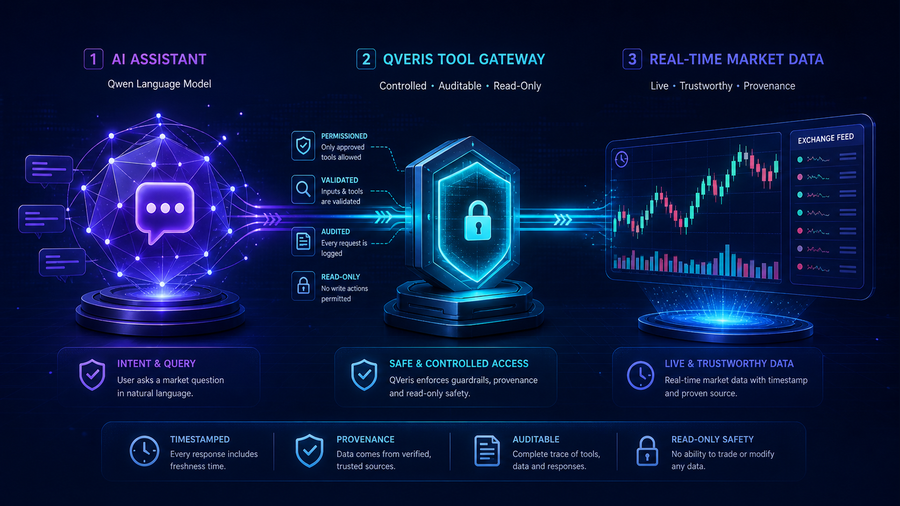
Why Qwen needs a market-data tool layer
Qwen can reason about a codebase, edit files, run commands, and use external tools. But a coding agent does not inherently know the current price of a stock. Its general knowledge is not a live feed, and ordinary web results can be delayed, inconsistent, or stripped of exchange timestamps.
The dependable pattern is to give the agent a small set of typed functions such as get_quote, get_bars, and get_market_status. Those functions call a licensed provider, normalize the response, and return the timestamp, source, currency, and feed status alongside the values. Qwen receives just enough evidence to build, test, or debug the feature.
Qwen Code officially supports MCP servers for connecting external tools and data sources. Its configuration and permission controls let you expose a focused, read-only market-data operation instead of granting broad shell or account access.
A production-shaped architecture
Separate the streaming pipeline from the agent interaction. A WebSocket consumer maintains the live state your application needs; an MCP endpoint exposes bounded snapshots and historical windows to Qwen. This prevents a long-lived firehose from flooding the context window while preserving freshness.
What the tool should return
A quote without context is an unsafe primitive. Return a structured envelope: symbol, bid, ask, last trade, exchange or feed, currency, provider timestamp, received timestamp, session state, delay classification, and an error field. For bars, state interval, adjustment policy, timezone, and whether the current bar is complete.
Implementation workflow
Define the question before choosing the feed
A portfolio dashboard may need minute bars; a spread monitor needs bid and ask; a market-open alert needs session status plus timestamps. Write the required symbols, venues, fields, freshness threshold, update rate, history depth, and whether the result will be displayed, stored, or redistributed.
Choose a provider and confirm entitlements
Compare exchange coverage, consolidated versus venue-specific feeds, delayed versus real-time access, WebSocket limits, historical depth, corporate-action adjustments, and display rights. For example, Alpaca documents its stock WebSocket feeds; its available feed and coverage depend on the subscription. Treat provider plan details as configuration, not timeless facts.
Wrap provider calls behind narrow MCP tools
Keep secrets in the MCP server environment. Validate symbols and time ranges, cap result size, normalize provider-specific fields, and add provenance. Qwen should request data by intent rather than construct arbitrary provider URLs.
// .mcp.json
{
  "mcpServers": {
    "market-data": {
      "type": "stdio",
      "command": "node",
      "args": ["./tools/market-data-server.js"],
      "env": { "MARKET_DATA_KEY": "${MARKET_DATA_KEY}" }
    }
  }
}
Register, reload, and constrain permissions
Qwen CLI supports project-level .mcp.json configuration. After a change, start a new session or run /mcp reload. Allow only the read functions required for this use case; keep trading, account mutation, and unrestricted network actions outside the server.
Prompt for evidence, not just a number
Ask Qwen to use the market-data tool, state the returned timestamp and feed, reject stale results, and separate observed values from calculations. A useful task reads: “Fetch the latest quote and five one-minute bars for AAPL. Fail if the newest observation is older than 90 seconds during regular market hours. Add a typed adapter and tests; do not place orders.”
Test live, closed-market, and degraded states
Record fixtures for a live session, pre-market or after-hours, a holiday, an unknown symbol, a rate-limit response, a disconnected stream, and delayed data. Verify reconnect backoff, deduplication, ordering, timezone conversion, and visible stale-state labels.
Choose the feed by workload
| Need | Preferred interface | Watch closely |
|---|---|---|
| Prompt-time quote or test fixture | REST / MCP snapshot | Timestamp, delay, venue, cache TTL |
| Live dashboard | WebSocket + local state | Reconnects, backpressure, symbol limits |
| Chart and indicator development | Historical bars + latest snapshot | Adjustments, missing bars, timezones |
| Alert prototype | Stream consumer + rule engine | Duplicate events, clock drift, delivery |
Use QVeris provider discovery to inspect available data providers, then confirm coverage and terms in the selected provider’s official documentation. For implementation, browse QVeris tools for a precise read operation instead of granting a broad integration.
Controls that make “real time” trustworthy
Use two clocks
Compare the provider event time with your gateway receipt time. A recent receipt can still contain an old market event.
Carry the feed identity
Record provider, feed, venue, delayed status, and adjustment policy with every result.
Keep it read-only
Market data and order execution should be different servers, credentials, and approval paths.
Degrade explicitly
Show stale, delayed, closed, and disconnected states. Never silently present cached data as live.
Release checklist
- API keys are server-side and excluded from logs, prompts, and version control.
- Every value has a source timestamp, receipt timestamp, currency, and session state.
- Schema validation rejects missing fields, non-finite numbers, and reversed time windows.
- Rate limits, reconnects, stale thresholds, and cache behavior are observable.
- Display and redistribution rights match the actual product behavior.
Three practical Qwen use patterns
Build a live dashboard adapter
Ask Qwen to create a provider-independent interface, implement one adapter, and render explicit loading, stale, delayed, and disconnected states. Use recorded fixtures for deterministic tests and the live MCP tool only for an opt-in smoke test.
Debug a price discrepancy
Give Qwen two attributed snapshots and ask it to compare timestamp, venue, trade versus quote, adjustment rules, and session. This turns “the prices differ” into a reproducible data-quality investigation.
Prototype an alert without enabling trading
Stream events into a small rule engine, expose recent triggers through a read-only tool, and let Qwen build the notification path. Keep execution credentials absent. An alert can be tested safely without creating a route to place an order.
Frequently asked questions
Can Qwen access real-time stock prices by itself?
Not as an inherent model capability. Connect a licensed data source through a controlled integration such as an MCP server, and include timestamps and provenance in every response.
Should the MCP tool expose a WebSocket stream directly?
Usually no. Let an application-side consumer maintain stream state and expose bounded snapshots to the agent. Direct streams can overwhelm context and complicate retries, ordering, and cancellation.
What is the minimum useful quote schema?
Symbol, bid, ask, last trade when available, currency, provider/feed, event timestamp, receipt timestamp, market-session state, delay classification, and a typed error status.
Can this workflow place trades?
This design is intentionally read-only. If execution is ever added, isolate it behind separate credentials, tools, permissions, confirmation, risk checks, and audit logs.
How do I test when the market is closed?
Use recorded, timestamped fixtures and simulate session states. Keep one opt-in live smoke test for connectivity, but do not make the core test suite depend on an open market.
Turn a live feed into a tool Qwen can use safely
Start with one read-only operation, one symbol, and an explicit freshness rule. Validate the envelope before expanding coverage.